I've been doing my own laundry for over 20 years. I own a bed. I buy sheets. And until a Friday in March 2026, I had never successfully folded a fitted sheet into anything resembling a neat rectangle. Every attempt ended the same way — a crumpled ball shoved into the back of the linen closet, hoping nobody would look.
I'd watched the videos. I'd tried the Martha Stewart method. I'd read the WikiHow articles with their baffling diagrams. Nothing clicked. The instructions always assumed you already knew the one thing they were supposed to be teaching.
"It will look like a lumpy, curved mess when you first lay it down. That's completely normal. Don't panic and start over."
Nobody had ever told me that before. That single piece of information — that the blob is supposed to look like a blob — unlocked the whole thing.
The Friday everything changed
My dog Moses was recovering from surgery. He was wearing his donut cone and very much not interested in going anywhere. I had a "cameras up" work day — the kind where you're technically present but have mental bandwidth to spare.
I cleared my dining table. I grabbed a sheet fresh from the laundry. And I decided that today was the day I was finally going to figure this out — not from a video, but by actually working through it step by step until it made sense.
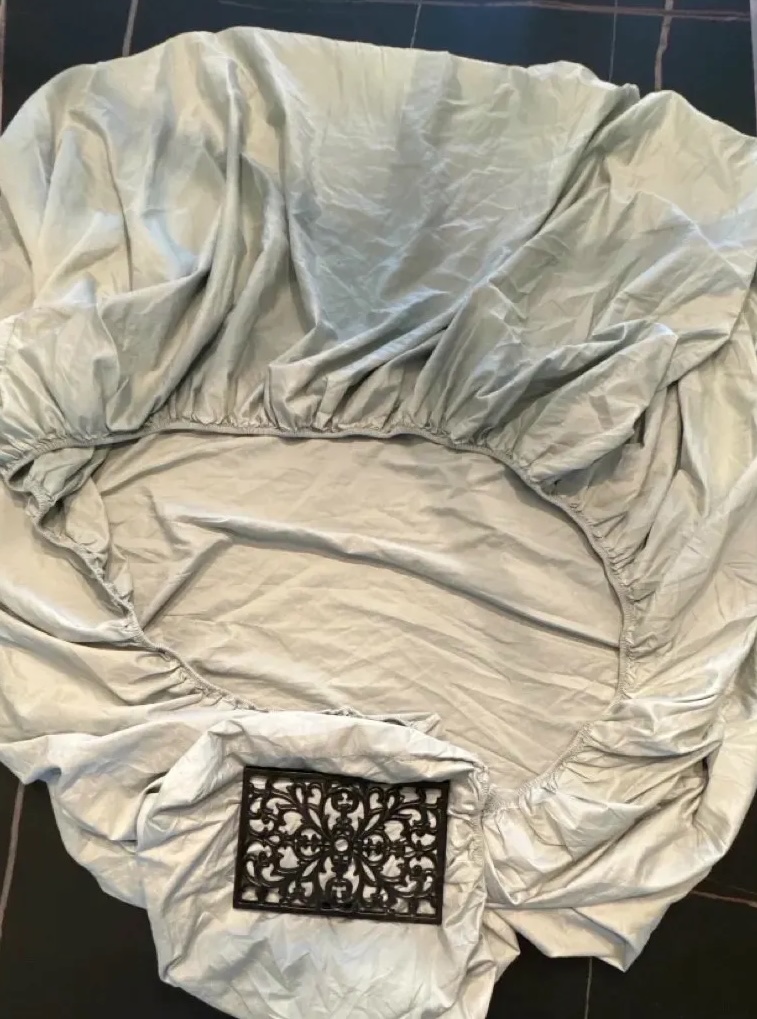
An hour in, I was winning. But there was one problem: every time I walked from one end of the table to the other to grab the far corners, the first pair of nested corners would slide off. I needed something to hold them in place.
I grabbed the cast iron trivet sitting on my counter and set it on top of the nested corners. Problem solved. The sheet stayed put, I walked to the far end, grabbed the remaining corners, and for the first time in my adult life — I had all four corners nested together.
But here's what I figured out next that nobody else teaches: after nesting the first two pairs, I slid my hands back inside both nested corner pockets — like putting on a hospital gown — and used that grip to push one pair through the other. When I picked the whole thing up and let it hang, it formed a smooth J-shape.
The candy cane.
That J-shape was the visual proof I'd always been missing. All four corners correctly nested. No guessing. No hoping. Just a clean curve that said: you've got it.
Why I built this site
After I finally cracked it, I went looking for a guide that explained it the way I'd just figured it out. There wasn't one. What existed was a collection of shaky iPhone videos, WikiHow diagrams that assumed knowledge they were supposed to impart, and tutorials written for right-handed people that never mentioned handedness once.
So I built it. Same day. I documented every step as I went — the exact hand positions, what you should be looking at at each stage, the re-mitten move nobody else mentions, and the cast iron trivet hack. I took the photos myself. I went from spending a morning failing to folding the sheet in under a minute.
🍬 The candy cane method
Named for the J-shape the sheet makes when you pick it up after nesting all four corners. That shape is your proof — a visual checkpoint that tells you you've got it right before you ever start folding. No other fitted sheet guide uses this as a checkpoint. As far as I can tell, no one has documented this method before.
Forty thousand people a month search for "how to fold a fitted sheet." Every one of them deserves a better answer than what was out there. That's why this exists.
— Pat, Alpharetta GA
P.S. Moses is a 130 lb Newfoundland who actually gets excited when he sees the donut cone coming out. Five days post-surgery and he's been a total champ. Good boy, Moses. 🐾